Skip to content

Thursday, October 1, 2026

  • NYSE 08:08 Closed
  • LSE 13:08 Open
  • Xetra 14:08 Open
  • HKEX 20:08 Closed
  • TSE 21:08 Closed
ValuSpectrum
  • World news
  • Business
  • Stock
  • Politics
  • Sport
Get the daily brief
ValuSpectrum
  • World news
  • Business
  • Stock
  • Politics
  • Sport
Subscribe
ValuSpectrum
  • World news
  • Business
  • Stock
  • Politics
  • Sport

What moved overnight and why it matters, in your inbox before the opening bell.

Get the daily brief
Business

US Navy Testing Robotic Refueling to Push Drone Boats Further

September 4, 2026 3 min read

The US Navy is testing whether it can robotically refuel naval drones at sea, a capability that could allow them to operate for longer in higher-threat waters.

Uncrewed surface vessels may not need a crew, but they still need fuel to operate. The recent test is a step toward a fully autonomous refueling process that Navy officials say could eventually let the service send uncrewed vessels into dangerous waters for longer without human support elements.

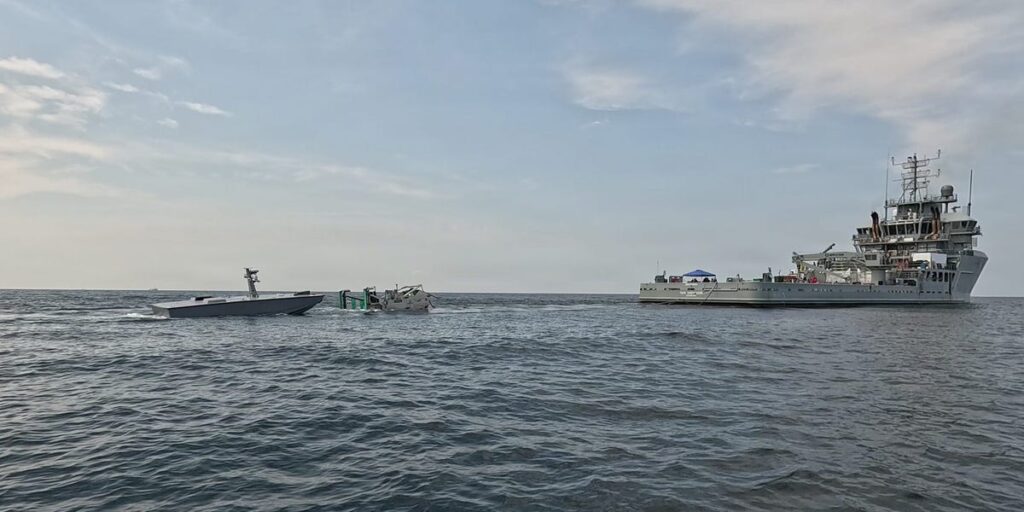
The Naval Air Warfare Center Weapons Division shared details Wednesday of a recent refueling demonstration involving the remotely controlled T38 USV built by Maritime Tactical Systems Inc. and a towable capture-and-connection robotic refueling system made by Sealartec.

During the testing in the waters off Joint Expeditionary Base Little Creek-Fort Story in Virginia, the drone and the refueling system completed dozens of capture, refuel, and release exercises. Four hundred gallons of fuel were transferred to the T38.

The immediate problem the Navy is trying to solve is tied to the Navy’s testing of hypersonic and other long-range weapons. Those tests, “where flight profiles can extend thousands of miles beyond fixed-range boundaries,” can “require data-collection assets to be distributed across a vast area,” Spencer Holloway, director of the division’s Blue Water Instrumentation Future Capabilities Office, said in a release.

A refueling probe on a naval drone approaches a towable capture and connection refueling device.

The drone’s refueling probe. 

Courtesy photo from Naval Air Warfare Center Weapons Division


Naval drones are useful for gathering that data, but having to return for fuel cuts into their time on station. Holloway said that “every time an unmanned vessel must return to port for fuel, we lose persistence, reduce coverage and redundancy, and interrupt the mission.”

The Navy sees a broader application as well.

“This will allow us to have greater reliance on unmanned vessels instead of manned, and we can push the USV into higher threat areas without risking manned vessels and personnel,” Ronald Raymer, branch head for capability, innovation, science and technology integration at US Fleet Forces Command, said in the release.

“It will also allow us to distribute greater capability into an area without having to invest in large expensive manned vessels,” he said.

Want more Business Insider in your news feed?

Add BI in Google so our reporting is easier to find when you’re searching for what matters.

The August demonstration was not fully autonomous. The Navy’s next step is a complete end-to-end test in which a drone boat can meet up with a robotic refueling system, approach it, connect, take on fuel, disconnect, and return to its mission without operator control every step of the way.

To do that, Holloway said, the systems involved will need more precise maneuvering and better local positioning.


Share
Previous story Smucker CEO Sells 84,821 Shares For $11.1 Million: Routine or Worrisome? Next story Politics Home Article | Senior Reform UK Aides Step Down After Undercover Report On Donations

More from this desk

Business

Google announces Gemini 4 Argon AI model, but you can’t use it yet

October 1, 2026
Business

OpenAI reportedly in talks to raise $30B round at $1.4T valuation

September 30, 2026
Business

Boeing 737 Max 10 certification delayed by software issue, FAA says

September 29, 2026

The daily brief

Markets, policy and technology — one short email each weekday morning.

Systems and Technologies LLC 1607 Capitol Ave, Cheyenne, WY 82001, USA

What patience paid

Put money into the S&P 500 at the start of a decade and leave it alone. This is what it became.

Amount invested
1920s 2010s
Worth today $256,742 25.7× over 36 years $98,853 in today’s money, after inflation

Decade-average price returns, before dividends and fees. Past performance does not guarantee future results.

Latest headlines

  1. 12:53 am From clean energy warrior to ‘wall of shame,’ James Talarico reverses on a fossil fuel money pledge
  2. 12:53 am Caitlin Clark, Kelsey Mitchell post big games to help Fever even series with 99-89 win over Aces
  3. 12:53 am UK believes Iran involved in RAF Fairford incident, Burnham says
  4. 12:53 am Where Cramer stands on a buzzy behind-the-meter name powering the AI build-out
  5. 12:53 am Google announces Gemini 4 Argon AI model, but you can’t use it yet

Desks

  • Politics 49
  • Stock 24
  • World news 24
  • Sport 24
  • Business 23

The brief, before the open

What moved overnight and what it means for the session ahead. One email, every weekday, in your inbox before the bell.

  • Three minutes to read, start to finish
  • Indices, FX, rates and crypto in one glance
  • US, Europe and Asia in every issue

Get tomorrow’s brief

Free. Unsubscribe with one click.

Systems and Technologies LLC 1607 Capitol Ave, Cheyenne, WY 82001, USA
ValuSpectrum

Markets, policy and the money behind both.

Independent reporting on what moves capital, published every weekday. The brief lands before the opening bell.

Get the daily brief

Desks

  • Politics
  • Stock
  • World news
  • Sport
  • Business

The site

Terms and conditionsPrivacy Policy

© 2026 valuspectrum.com. All rights reserved.

Market figures are for information only and are not investment advice.

Get the brief in your inbox

Market-moving news and analysis, delivered every weekday before the opening bell.

Systems and Technologies LLC 1607 Capitol Ave, Cheyenne, WY 82001, USA